
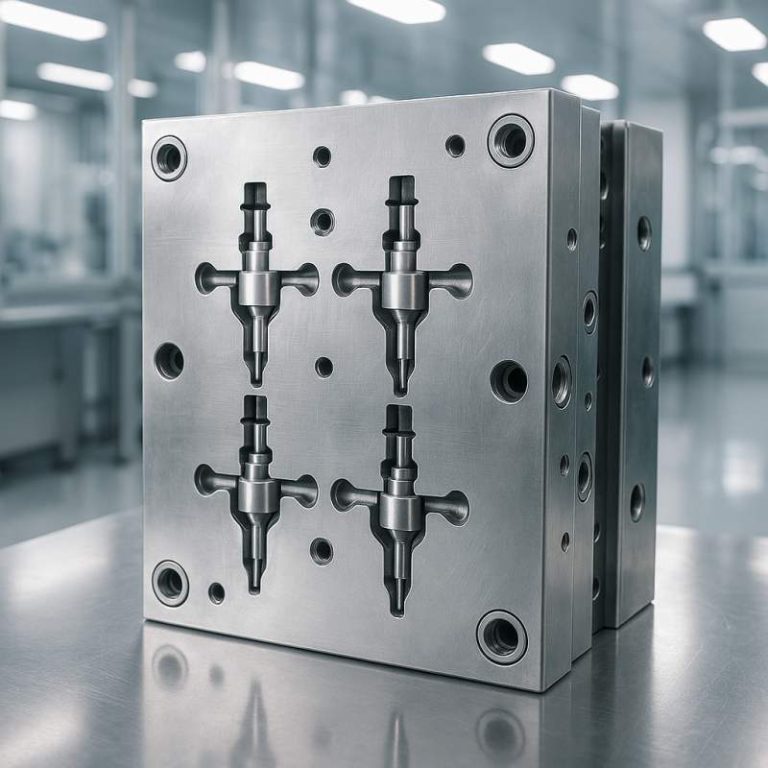
Medical Injection Molding is a high-precision manufacturing process in which biocompatible polymers are injected under strictly controlled temperature and pressure into high-tolerance molds to produce medical components with dimensional tolerances below 0.01 mm. This technology serves as the backbone for over 70% of disposable plastic medical devices manufactured worldwide.
What Sets This Article Apart?
Most literature on medical mold making focuses predominantly on regulatory standards and raw materials. Yet, an overlooked industry reality persists: over 40% of plastic medical product failures across Iran and the Middle East stem not from substandard raw materials, but from flawed mold design and tooling defects.
This article bridges that critical gap—analyzing the sector strictly through the lens of mold engineering, rather than treating it merely as a raw-material supply chain issue.
1. What Is a Medical Device Injection Mold?
Functional & Engineering Definition
A medical device injection mold refers to an assembly of high-precision machined steel or aluminum tooling engineered specifically to fabricate plastic components intended for healthcare applications. These encompass an extensive spectrum of products:
- Disposable syringes
- Catheters and medical-grade tubing
- Enclosures for diabetes care devices (glucometers, insulin pumps)
- Surgical connectors and fluid management fittings
- Ventilator and anesthesia machine components
- Laboratory diagnostic and specimen collection containers
- Temporary bio-absorbable / resorbable implants
Core Distinction: Standard Industrial Tooling vs. Medical-Grade Tooling
In general industrial injection molding, dimensional tolerances ranging from ±0.1\pm 0.1±0.1 to 0.5 mm0.5\text{ mm}0.5 mm are widely accepted. In medical-grade injection molding, however, tolerance requirements routinely tighten to sub-0.01 mm0.01\text{ mm}0.01 mm levels. Key technical distinctions include:
| Parameter | Standard Industrial Mold | Medical-Grade Mold |
|---|---|---|
| Dimensional Tolerance | ±0.1−0.5 mm\pm 0.1 – 0.5\text{ mm}±0.1−0.5 mm | ±0.005−0.01 mm\pm 0.005 – 0.01\text{ mm}±0.005−0.01 mm |
| Production Environment | Standard shop floor | ISO Class 7 / Class 8 Cleanroom |
| Documentation & Compliance | Optional / Commercial grade | Mandatory (FDA / ISO 13485 / DQ-IQ-OQ-PQ) |
| Material Traceability | Not strictly required | 100% Full Lot Traceability |
| Sterilization Compatibility | Not required | EtO, Gamma Irradiation, Autoclave |
| Tool Life (Expected Shots) | 500K−1M500\text{K} – 1\text{M}500K−1M cycles | 1M−5M+1\text{M} – 5\text{M}+1M−5M+ cycles (Class 101 Tooling) |
2. Why Is the Healthcare Sector Bound to Injection Molding?
The Economic & Technical Rationale
The premise is straightforward: no competing manufacturing technology delivers this precise intersection of dimensional accuracy, high-volume throughput, and unit-cost efficiency.
Consider a standard 5 mL5\text{ mL}5 mL syringe. This single component must satisfy rigorous constraints simultaneously:
- Maintain total sterility.
- Exhibit proven biocompatibility upon direct blood or tissue contact.
- Feature critical volumetric dimensions to ensure accurate drug dosing.
- Run at cycle times under 3 seconds.
- Maintain a target unit cost well below a fraction of a cent.
Only high-cavitation injection molding (Multi-cavity Tooling) operating at high cavitation densities can satisfy all these stringent benchmarks concurrently.
Global Market Dynamics
- Global Medical Plastic Injection Molding Market (2025): $23.5 Billion
- Compound Annual Growth Rate (CAGR): 6.8%
- Asia’s Share of Global Manufacturing: 38%
- Dominant Application Segment: Disposable Devices (commanding a 45% market share)
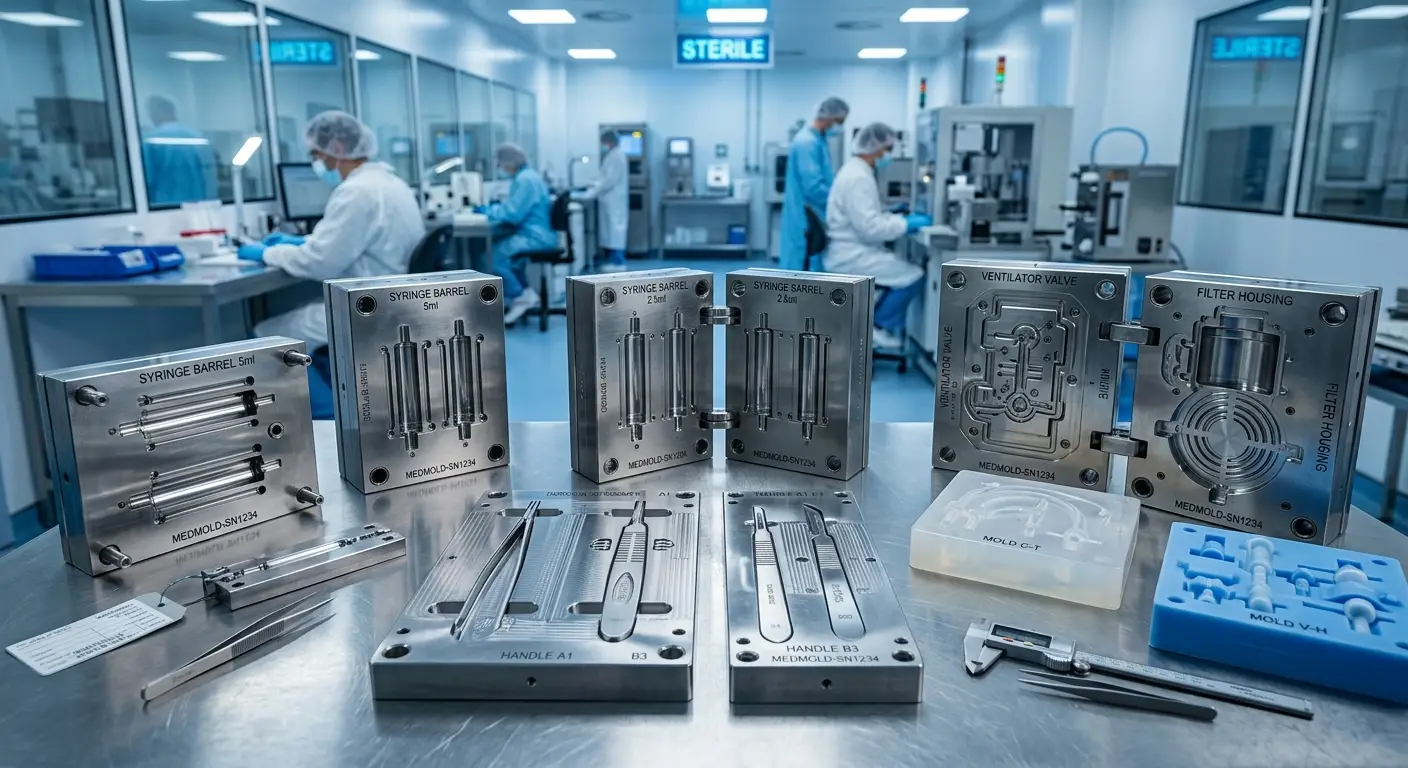
Mold Classification from an Engineering Perspective
-
Single-Cavity Molds
Designed for components featuring complex geometries or low-volume production runs. Commonly utilized in:
- Dental prosthetics
- Implantable surgical components
- Rapid prototyping and initial sampling (Prototype Molds)
-
Multi-Cavity Molds
Engineered for mass production of high-consumption commodities. Configured with 4, 8, 16, 32, or even 64 cavities within a single tool. Primary advantage: A 60% to 80% reduction in unit production cost.
-
Family Molds
Integrates multiple distinct components produced simultaneously within a single injection cycle. Example: The housing, cap, and gasket of a medical fluid connector.
-
Insert Molding
The process of injecting molten polymer over pre-placed metal inserts. Extensively applied in:
- Medical electrodes
- Implantable sensor housings
- Metal-reinforced surgical handpieces and instruments
-
Overmolding
Sequential injection of a secondary layer (typically TPE or liquid silicone) over a previously molded primary substrate. Result: Achieves an ergonomic grip and hermetic sealing in a single integrated operation.
-
Micro-Molding
Engineered for ultra-miniaturized components weighing less than 1 gram. Utilized in:
- Smart drug delivery capsules
- Micro-catheters
- Intraocular Lenses (IOLs)
4. Raw Materials: The Determinant Between Success and Failure
Comprehensive Guide to Medical Polymer Selection
This is the single most critical decision in medical mold design. Incorrect material selection equals total capital investment loss.
High-Consumption Medical Polymers
-
Medical-Grade Polypropylene (PP)
- Applications: Syringes, specimen containers, test tubes.
- Advantages: Excellent chemical resistance; fully autoclavable.
- Limitations: Low transparency; moderate impact resistance.
-
Medical-Grade Polycarbonate (PC)
- Applications: Device housings, diagnostic equipment enclosures.
- Advantages: High optical clarity; exceptional impact strength.
- Limitations: Sensitive to certain chemical solvents; requires rigorous pre-drying prior to processing.
-
Medical-Grade ABS
- Applications: Diagnostic device exteriors and structural casings.
- Advantages: Superior machinability; excellent paintability and aesthetics.
- Limitations: Poor UV resistance; limited chemical resistance profile.
-
PEEK (Polyether Ether Ketone)
- Applications: Orthopedic implants, multi-use reusable surgical components.
- Advantages: Outstanding biocompatibility; continuous thermal resistance up to 250°C; radiolucent.
- Limitations: Material cost is 15x to 50x higher than PP; demands processing melt temperatures of 380°C–400°C.
-
Medical-Grade TPE / TPU
- Applications: Flexible tubing, sealing gaskets, soft-touch ergonomic grips.
- Advantages: Tactile softness combined with seamless overmolding capability.
- Limitations: Lower dimensional precision compared to rigid engineering thermoplastics.
-
Liquid Silicone Rubber (LSR)
- Applications: Respiratory masks, open-heart surgical tubing, check-valve diaphragms.
- Advantages: Extraordinary biocompatibility; thermal stability ranging from −55°C to 250°C.
- Limitations: Requires specialized injection systems (Cold Runner Systems); high tooling and material overhead.
Comprehensive Medical Material Comparison Matrix
| Material | Biocompatibility Standard | Sterilization Threshold | Relative Cost Index | Primary Application |
|---|---|---|---|---|
| Medical PP | ISO 10993 | Autoclave ✓ | 1× | Syringes, Specimen Vials |
| Medical PC | USP Class VI | Limited | 3× | Device Housings |
| Medical ABS | USP Class VI | EtO ✓ | 2× | Diagnostic Equipment |
| PEEK | ISO 10993 | All Methods ✓ | 40× | Orthopedic Implants |
| Medical TPU | ISO 10993 | Gamma Irradiation ✓ | 5× | Flexible Tubing |
| LSR | USP Class VI | Autoclave ✓ | 15× | Respiratory Masks, Diaphragms |
| Ultem (PEI) | USP Class VI | All Methods ✓ | 25× | Reusable Medical Instruments |
5. Mandatory Standards and Certifications
What Regulatory Frameworks Are Non-Negotiable?
This section is frequently overlooked in domestic technical literature, yet without these rigorous certifications, commercial market entry is virtually impossible.
International Regulatory Standards
-
ISO 13485:2016
The paramount quality management system standard dedicated to medical devices. Every medical mold manufacturer must maintain:
- Comprehensive documentation control systems.
- 100% full raw material traceability.
- Structured Mold Validation protocols (IQ/OQ/PQ).
-
ISO 10993 — Biocompatibility Evaluation
Mandatory biological safety testing for any material entering direct or indirect patient contact:
- Cytotoxicity
- Sensitization testing
- Irritation and intracutaneous reactivity
- Acute systemic toxicity
-
FDA 21 CFR Part 820
Essential for US market access, enforcing strict cGMP (Current Good Manufacturing Practice) regulations for medical device production.
-
EU MDR 2017/745
European Union Medical Device Regulation, replacing the legacy MDD framework with significantly heightened clinical scrutiny and post-market surveillance demands.
Regional Standards (Iran Context)
- National ISIRI standards for designated medical hardware.
- Iran FDA (IFDA) manufacturing and import clearance licenses.
- Widespread voluntary and mandatory implementation of ISO 13485 compliance across leading Iranian precision mold-making facilities.

برای تصمیمگیریهای فنی نهایی، حتماً با متخصص شرکت بارمان صنعت فاخر مشورت کنید.

