
Fluoropolymers, particularly PFA (perfluoroalkoxy polymer), are the backbone of modern advanced industries due to their unparalleled chemical and thermal resistance. Unlike PTFE, which is non-meltable, PFA offers similar properties but can be shaped into highly complex and customized forms through injection molding.
If you’re a design engineer or supply chain manager seeking to produce industrial parts with the highest level of chemical durability, this article is your comprehensive guide to understanding the custom production and injection molding process of PFA. For more information, contact us.
For free consultation, instant pricing inquiries, and ordering, call:
021-56575111 (Office line)
0912-3221757 (Direct consultation)
0900-9504025 (Sales support)
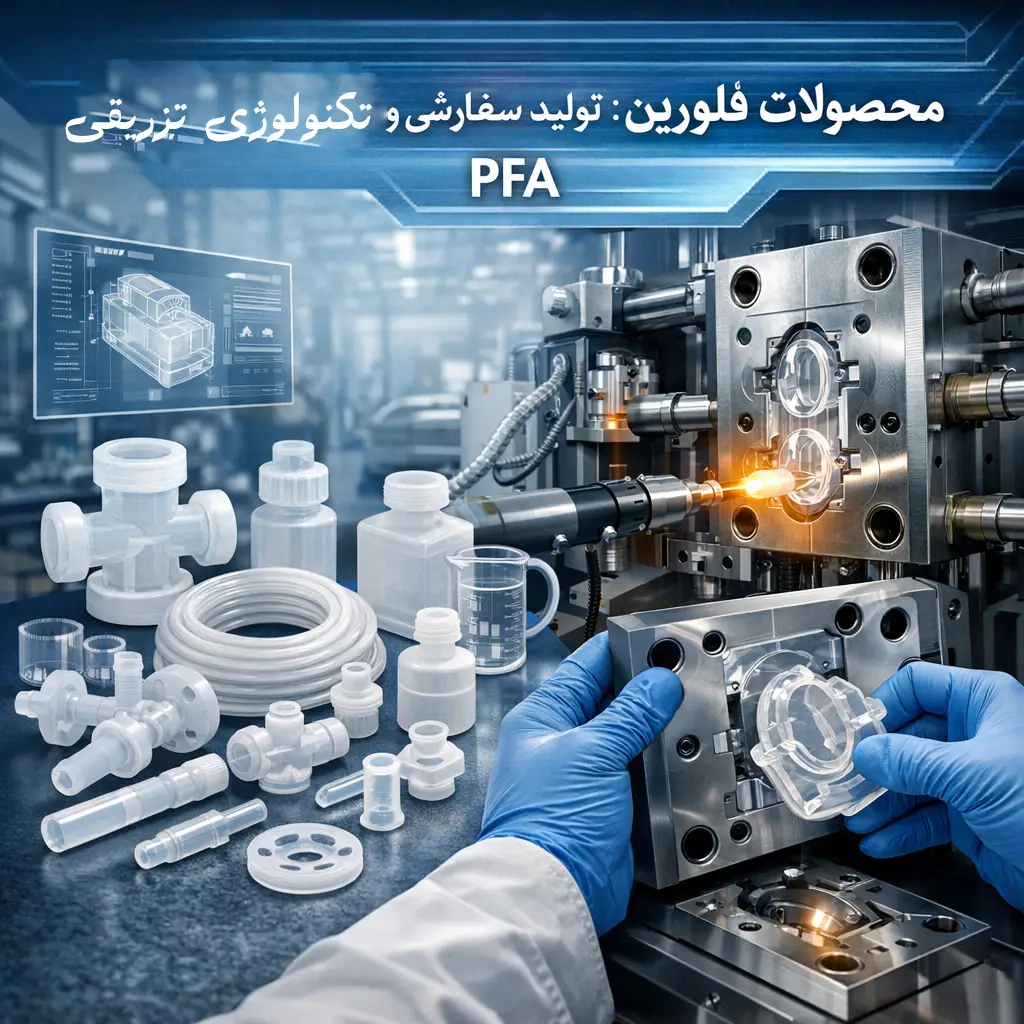
Florine Products and the Role of PFA in Industry
Floro-polymers are high-performance engineering plastics with a strong carbon-fluorine (C-F) bond in their molecular structure. This bond imparts exceptional stability against chemicals and heat.
PFA (perfluoroalkoxy) polymer is one of the most advanced members of this family. This material maintains its performance across a wide temperature range (-200°C to +260°C). Its melting point is typically known as Tm ≈ 305°C, making the production process highly sensitive.
For free consultation, instant price quotes, and ordering, contact:
☎️ 021-56575111 (Office line)
📱 0912-3221757 (Direct consultation)
📱 0900-9504025 (Sales support)
Why Choose PFA Over PTFE?
The primary limitation of Teflon (PTFE) is its very high viscosity in molten state, rendering injection molding impossible. PFA, due to structural modifications, exhibits melt-processability. This feature allows us to manufacture custom parts with complex geometries, tight tolerances, and thin walls using plastic injection molding.
Choosing between PFA (perfluoroalkoxy) and PTFE (polytetrafluoroethylene) is a common challenge in engineering design. While both polymers belong to the floropolymers family and offer unparalleled chemical resistance, differences in their molecular structure lead to fundamental distinctions in processability methods, physical properties, and cost.
| ویژگی مهندسی | PFA (پرفلوروآلکوکسی) | PTFE (پلیتترافلورواتیلن) | اهمیت در تصمیمگیری مهندسی |
|---|---|---|---|
| قابلیت قالبگیری و فرآیندپذیری | عالی. قابلیت تزریق پلاستیک و اکستروژن را دارد. | ندارد. تنها با فشردهسازی، پخت و ماشینکاری شکل میگیرد. | بسیار بالا: تنها گزینه برای تولید انبوه قطعات با هندسه پیچیده. |
| مقاومت حرارتی (کارکرد مداوم) | تا $260^\circ C$ | تا $260^\circ C$ | پایین: عملکرد هر دو در تحمل حرارت مداوم یکسان است. |
| شفافیت اپتیکی | نیمهشفاف تا کاملاً شفاف | کدر و مات (سفید رنگ) | متوسط: PFA برای سیستمهای نیازمند مشاهده سیال برتری دارد. |
| هزینه و قیمت مواد خام | بسیار گرانتر | مقرونبهصرفهتر و ارزانتر | بالا: در قطعات ساده و پروژههای با بودجه محدود، PTFE ارجح است. |
| مقاومت در برابر خمش مکرر | فوقالعاده بالا | متوسط تا خوب | بالا: PFA برای شیلنگهای تحت لرزش و قطعات متحرک عمر بیشتری دارد. |
| تخلخل و صافی سطح | کاملاً یکپارچه، بسیار صاف و بدون تخلخل | دارای ریزتخلخل ناشی از فرآیند پخت | بسیار بالا: PFA در صنایع نیمههادی و دارویی بیرقیب است. |
| مقاومت شیمیایی | عالی (خنثی در برابر اکثر حلالها) | عالی (خنثی در برابر اکثر حلالها) | پایین: هر دو ماده مقاومت شیمیایی بینظیری ارائه میدهند. |
**Quick Decision Guide for Engineers: Choosing Between PFA and PTFE for Molding**
Select **PFA (Polytetrafluoroethylene)** if: Your part has a complex geometry, requires injection molding, transparency is essential for fluid visibility, or the part is subjected to continuous bending and vibration (such as semiconductor industries, specialized medical equipment, and sensors).
Choose **PTFE (Polytetrafluoroethylene)** if: The part has a simple geometry (like gaskets, O-rings, and sheets), is easily machinable, and project cost control is a top priority.
**Specialized Challenges in PFA Injection Molding**
Custom production using PFA material is not a standard plastic injection process. It requires specialized machinery, deep metallurgical knowledge, and precise thermodynamic settings.
1. **Corrosion Resistance in Molds and Machinery**
When PFA reaches its melting point (around 300-380°C), it releases small amounts of fluorine-containing gases (such as hydrogen fluoride). These gases are highly corrosive.
Therefore, for custom production, all components of the injection molding machine (cylinder, screw, nozzle) and the mold itself must be made from highly corrosion-resistant alloys like Hastelloy or special-coated stainless steels.
2. **Precision Temperature Control (Thermal Management)**
Fluorine polymers have a high specific heat capacity. If temperature distribution within the injection cylinder is uneven, PFA will suffer from thermal degradation, significantly reducing the mechanical properties of the final part. PID temperature control systems with ±1°C accuracy are mandatory.
3. **Shrinkage Rate Management**
PFA has a relatively high shrinkage rate during cooling (typically 3-6%). In designing custom molds, our engineers use Moldflow simulation software to calculate this shrinkage, ensuring the final part dimensions precisely match the client’s drawing.
**Applications of PFA Injection-Molded Parts**
PFA’s molding capabilities enable the production of critical parts with the highest quality for the following industries:
Semiconductor Industry: Manufacturing connectors, wafer containers, and valves due to the extremely high purity of fluorine products.
Chemical and Petrochemical Industries: Producing custom pump impellers, rings, and gaskets exposed to strong acids.
Medical and Pharmaceutical Equipment: Fabricating components
**Stages of Fluorine Part Production Order**
If you intend to produce a part made of PFA, the standard collaboration process is as follows:
**Review and Feasibility Study:** Analyze your 3D CAD files and check the draft angle and wall thickness.
**Simulation and Mold Design:** Design the mold, considering the rheological behavior of molten PFA, and manufacture it with corrosion-resistant alloys.
**Prototype Production:** Conduct trial injection molding and perform dimensional checks and quality control tests.
**Mass Production:** Set up the plastic injection molding line for high volumes while maintaining quality stability.
**Frequently Asked Questions**
**Is PFA injection molding more expensive than other plastics?**
Yes. Due to the high cost of fluorine raw materials, the need for corrosion-resistant machines, and very high processing temperatures, PFA production costs are higher than those of conventional engineering plastics, but the longevity and durability of the parts offset these costs.
**What is the maximum operating temperature for PFA injection-molded parts?**
PFA parts can continuously operate at 260°C (260∘C) without losing their mechanical or chemical properties.
**Can transparent parts be produced with PFA?**
Yes. One of the significant advantages of PFA over PTFE is its transparency (Translucency). This feature makes it suitable for producing chambers and tubes that require fluid flow observation (such as chemical and semiconductor industries).
For free consultation, instant pricing, and order placement:
☎️ 021-56575111 (Special Office Line)
📱 0912-3221757 (Direct Consultation)
📱 0900-9504025 (Sales Support)

