
Here is the professional and accurate English translation of the text:
Producing industrial components with minimal waste, high precision, and unparalleled strength has always been a major challenge in manufacturing and production engineering. This is where an important question arises: What is powder metallurgy, and how has it revolutionized the production of complex parts (such as automotive gears and cutting tools)?
In this article, not only do we provide a comprehensive and practical overview of the powder metallurgy process, but we also deeply analyze the beating heart of this method—the powder metallurgy die (mold), its construction materials, and its design principles.
For a free consultation, real-time price inquiries, and order placement, please contact us:
- 021-56575111 (Office Special Line)
- 0912-3221757 (Direct Consultation)
- 0900-9504025 (Sales Support)
What is Powder Metallurgy? (PM)
Powder Metallurgy (PM) is an advanced metal-forming process in which metal powders are compacted under high pressure within a specially designed die, and subsequently sintered in high-temperature furnaces (below their melting point) to achieve their ultimate structural strength.
Unlike traditional methods such as casting, where the metal is melted, or machining, which involves material removal, powder metallurgy is a “Net-Shape Manufacturing” method. This means that in 95%95\% of cases, the manufactured component requires absolutely no secondary operations.
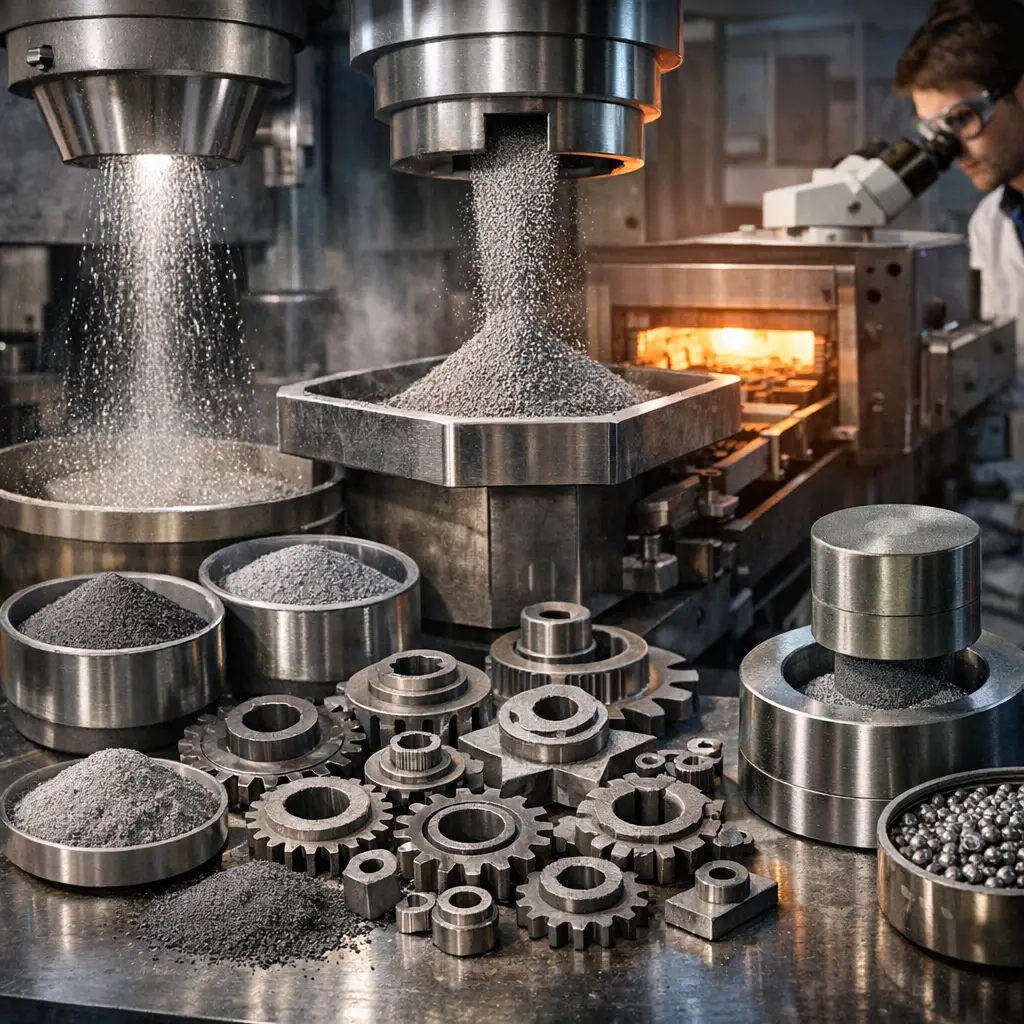
33 Main Steps in the Powder Metallurgy Process
To better understand this technology, you need to know that this process consists of three fundamental steps:
- Powder Preparation and Blending: Metal powders (iron, copper, aluminum, etc.) are mixed with solid lubricants (to reduce die friction) with high precision.
- Compaction (Pressing): The blended powder is poured into the powder metallurgy die and compacted by mechanical or hydraulic presses with a pressure between 150150 to 900900 MPa. At this stage, the part is called a “Green Compact,” which is highly fragile.
- Sintering: The green compact enters a furnace with a controlled atmosphere. At this stage, the powder particles weld together at the atomic level (without melting), and the part achieves its final mechanical strength.
The Powder Metallurgy Die: The Beating Heart of the Process
Many people are familiar with the powder production process but overlook the importance of the die. The quality, dimensional accuracy, and structural integrity of the final part directly depend on the design and manufacturing of the powder metallurgy die.
For free consultation, real-time price inquiries, and order placement, please contact:
- Office Special Line: 021−56575111021-56575111
- Direct Consultation: 0912−32217570912-3221757
- Sales Support: 0900−95040250900-9504025
Main Components of a Die in Powder Metallurgy
A tooling set in this method typically consists of the following main components:
- Die: The main cavity of the mold that determines the outer shape of the part.
- Upper Punch: Enters the die from above and applies the pressing force.
- Lower Punch: Forms the bottom of the die cavity and is responsible for the ejection of the part after pressing.
- Core Rod: Used when holes need to be created within the part.
What is the Material of Powder Metallurgy Dies?
Since the compaction pressure (based on the physical equation for pressure P=FAP = \frac{F}{A}) is extremely high and metal powder particles are highly abrasive, the dies must be manufactured from highly resistant materials:
- Cold Work Tool Steels (e.g., D2 and D3): Suitable for low and medium production runs. They offer good wear resistance but will wear out in high-volume production.
- High-Speed Steels (HSS): Provide higher strength and toughness compared to the D-series and are utilized for more complex parts.
- Tungsten Carbide: The best and most expensive choice for dies in production runs of millions. The wear resistance of tungsten carbide is unparalleled, keeping the part dimensions completely stable for hundreds of thousands of strokes.
44 Vital Principles in Powder Metallurgy Die Design
Designing these dies requires a profound understanding of solid mechanics. The most critical points that designers must adhere to include:
- Elimination of Undercuts: Parts with lateral protrusions or depressions cannot be produced using this method, as the part cannot be ejected from the die after pressing.
- Clearance: The gap between the punch and the die must be at the micron level (usually between 0.010.01 to 0.020.02 mm) to prevent powder leakage and punch jamming.
- Uniformity of Thickness: Due to the incomplete transfer of hydrostatic pressure in dry powders, parts with vastly varying thicknesses will suffer from density variations.
- Draft Angle: In certain parts, a very slight draft angle is incorporated to prevent cracking during ejection from the die.
Advantages and Limitations of Powder Metallurgy
To better understand why industries have gravitated toward this method, review the following table:
| Advantages of Powder Metallurgy | Limitations and Disadvantages |
|---|---|
| Production of complex parts with extremely tight tolerances | Very high initial cost of die manufacturing |
| Reduction of material waste to less than 3%3\% | Limitation in part size (requires massive presses for large parts) |
| Ability to produce special and porous alloys (like filters and bearings) | Inability to produce parts with internal threads or cross-holes during the pressing stage |
| High speed in mass production | Lower yield strength compared to forged parts |
For free consultation, real-time price inquiries, and order placement, please contact:
- Office Special Line: 021−56575111021-56575111
- Direct Consultation: 0912−32217570912-3221757
- Sales Support: 0900−95040250900-9504025
Industrial Applications
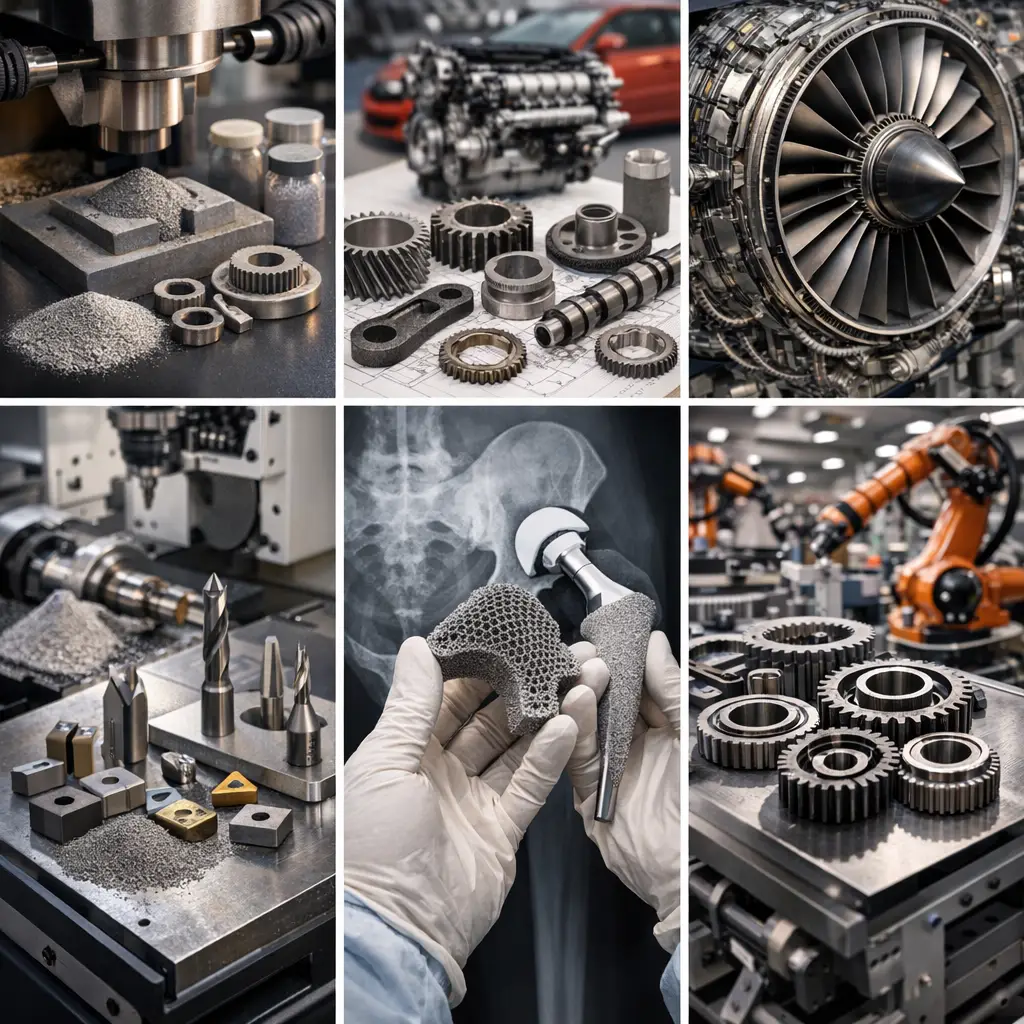
With advancements in the design of powder metallurgy molds, this method is widely used today in sensitive industries:
- Automotive Industry: Over 70%70\% of the parts produced by this method are used in vehicles (gearbox gears, oil pump rotors, engine components).
- Tooling: Production of turning inserts and cutting tools.
- Medical Equipment: Implants and precise surgical instruments.
- Home Appliances: Washing machine motor parts, meat grinders, etc.
Frequently Asked Questions
1. What exactly is Powder Metallurgy?
Powder metallurgy is an advanced industrial part production method in which metal powders (or a combination of metals and non-metals) are compressed inside a mold under high pressure and then heated in controlled-atmosphere furnaces at a temperature below the melting point of the base metal (sintering or particle-bonding operation). This process results in the production of parts with precise dimensions and desirable physical properties.
2. What are the main production stages in powder metallurgy?
This process generally consists of four essential stages:
- Powder Production: Manufacturing metal powders through methods such as atomizing (powdering with water or gas pressure), chemical reduction, or electrolytic methods.
- Blending: Mixing different powders together and adding lubricants (like zinc stearate) to reduce friction during pressing.
- Compaction: Pressing the powder mixture inside steel or carbide molds under high pressure (usually between 150150 to 900900 MPa) to create a Green Compact.
- Sintering: Heating the green compact in a protective environment so that the powder particles bond together through atomic diffusion, without melting.
3. What is the main difference between powder metallurgy and casting?
The fundamental difference lies in the state of the material during shaping. In casting, the metal is completely melted and poured into the mold in a liquid state; however, in powder metallurgy, the metal never reaches the liquid phase (except in special cases called liquid-phase sintering). This characteristic makes powder metallurgy the only viable method for metals with extremely high melting points (like tungsten) and also eliminates problems such as shrinkage cavities caused by solidification in casting.
4. Why do industrialists prefer powder metallurgy over machining?
The most important reasons are:
- Near Net Shape: Produced parts require no secondary machining or very minimal amounts of it.
- High Material Efficiency: In this method, over 97%97\% of the raw materials are converted into the final part, whereas in machining, sometimes up to 50%50\% of the material is wasted as chips.
- Production of Special Alloys: The ability to combine materials that do not mix in a molten state (like metals and ceramics for brake pad production).
- Porosity Control: The ability to produce parts with a specific porosity percentage (such as metal filters or self-lubricating bearings).
For free consultation, real-time price inquiries, and order placement, contact us:
- 021-56575111 (Office Special Line)
- 0912-3221757 (Direct Consultation)
- 0900-9504025 (Sales Support)
5. What are the limitations and disadvantages of powder metallurgy?
- High Equipment Cost: The price of molds and presses is very high.
- Geometric Limitations: It is not possible to create cross-holes (perpendicular to the pressing direction) or direct threading during pressing; secondary operations are required.
- Size Limitations: Producing extremely large parts is not technically or economically justifiable due to the need for exceptionally high press tonnage (most parts from this method weigh less than 22 kg).
- Mechanical Properties: Due to the presence of fine porosity, the impact and fatigue strength of these parts are usually slightly lower than forged parts.
6. What materials can be used in powder metallurgy?
The most widely used materials include:
- Iron and Steel Powder: Comprises over 80%80\% of global production volume (used in gears and automotive parts).
- Copper and its Alloys (Brass and Bronze): For electrical components and bearings.
- Aluminum and Titanium: For the aerospace industry (due to the high strength-to-weight ratio).
- Refractory Metals: Tungsten, molybdenum, and tantalum (manufacturing lamp filaments and cutting tools).
- Carbides: Tungsten carbide (Cermets) for machining tools and drill bits.
7. Where are the most important industrial applications of powder metallurgy parts?
- Automotive Industry: Oil pump gears, connecting rods, gearbox parts, brake system components (largest market share).
- Medical Equipment: Dental and orthopedic implants (such as porous titanium hip joints for bone ingrowth).
- Tooling: Turning and milling inserts.
- Home Appliances: Washing machine motor parts, meat grinders, and power tools.
8. Do powder metallurgy parts always have porosity?
Yes, the nature of this process is associated with some porosity. The relative density of a part is usually calculated using the following formula:
ρrelative=(ρsinteredρtheoretical)×100 \rho_{relative} = \left( \frac{\rho_{sintered}}{\rho_{theoretical}} \right) \times 100
Where ρtheoretical\rho_{theoretical} is the density of the solid metal. Usually, the density of sintered parts is between 85%85\% to 95%95\% of full density. However, if a completely solid part (100%100\% density) is required, methods such as Hot Isostatic Pressing (HIP) or powder forging are used.
9. How do Self-lubricating Bearings work?
These bearings are one of the masterpieces of powder metallurgy. In this case, the part is produced with controlled porosity (about 20%20\% to 25%25\% void space). The part is then immersed in hot oil under a vacuum so that its pores are filled with oil. During engine operation, the heat generated by friction causes the oil to expand and seep to the surface of the bearing, and upon stopping, the oil is drawn back into the capillary pores.
10. Economically, at what production volume is the use of powder metallurgy logical?
Due to the very high initial cost of designing and manufacturing precise molds (made of hot-work tool steels or carbides), this method is absolutely not cost-effective for low-volume productions. As a standard, the break-even point to economically justify powder metallurgy is the production of at least 10,00010,000 to 20,00020,000 parts per year. In millions of production volumes, this is considered the cheapest and fastest method for producing complex metal parts.
11. Is the safety of powder metallurgy workshops different from ordinary workshops?
Yes. Metal powders (especially aluminum, titanium, and magnesium powders) are highly reactive due to their very high surface area. The risk of a Dust Explosion is very high in the absence of proper ventilation and the presence of sparks. Therefore, powder storage, grounding systems, and ventilation require stricter safety standards than traditional machining workshops.
Conclusion
In response to what powder metallurgy is, it must be said: it is an engineering art for converting fine metal particles into strong and precise parts. However, the secret to the success of this method lies hidden in the precision and engineering of the powder metallurgy mold. Selecting the right material for the mold (such as tungsten carbide) and adhering to design principles (preventing sudden thickness changes and undercuts) guarantees the production of high-quality and economical parts in high volumes.
For free consultation, real-time price inquiries, and order placement, contact us:
- 021-56575111 (Office Special Line)
- 0912-3221757 (Direct Consultation)
- 0900-9504025 (Sales Support)

