
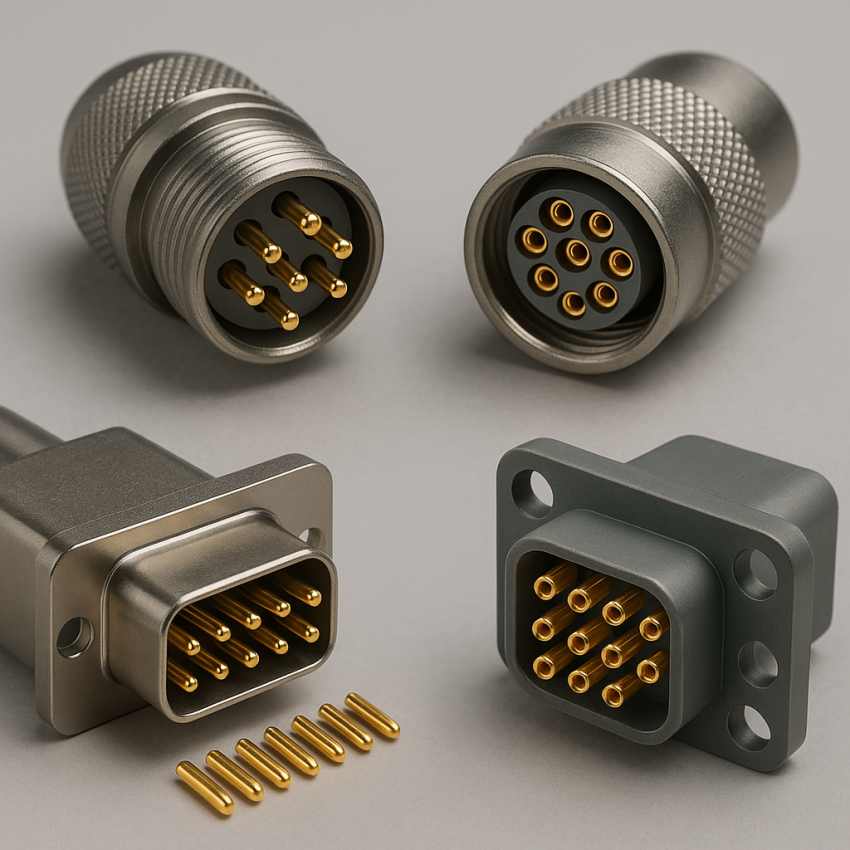
Selecting the right connector is the defining line between the flawless operation of a complex system and costly failures. In critical industries such as medical equipment, aerospace, and industrial automation, standard connectors simply do not suffice; this is where Precision Connectors (male and female) come into play.
In this article, we take an engineering approach to examine the various types of these connectors, their operational mechanisms, and crucial standards, enabling you to make the optimal choice for your industrial projects.
Still unsure about the right precision connector for your project?
An incorrect choice of material or IP rating can lead to a voltage drop (ΔV\Delta V) or production line downtime. Our engineering team is ready to recommend the most reliable option tailored to the rigorous standards of your project.
[Request Engineering Consultation]
What is a Precision Connector and How Does It Differ from Standard Types?
Precision connectors are electromechanical devices designed to establish secure signal, power, or data connections in demanding environments. Their primary differences from standard connectors come down to three key factors:
- Mating Cycles: Precision connectors can withstand over 5,000 mating and unmating cycles without any degradation in performance.
- Contact Resistance: In these connectors, the pin plating (typically gold or specialized alloys) is engineered to minimize ohmic resistance. In engineering design, the voltage drop is calculated using the formula ΔV=I×Rc\Delta V = I \times R_c. In precision connectors, the variable RcR_c (contact resistance) is kept to a mere few milliohms.
- Insulation and Sealing: They support IP68 standards and above, enabling reliable operation in vacuum or underwater conditions.
Classification of Precision Male and Female Connectors Based on Locking Mechanisms
The most critical criterion in industrial precision connectors is the engagement method between the male part (plug) and the female part (receptacle). This mechanism ensures that industrial vibrations do not result in connection failures or signal loss.
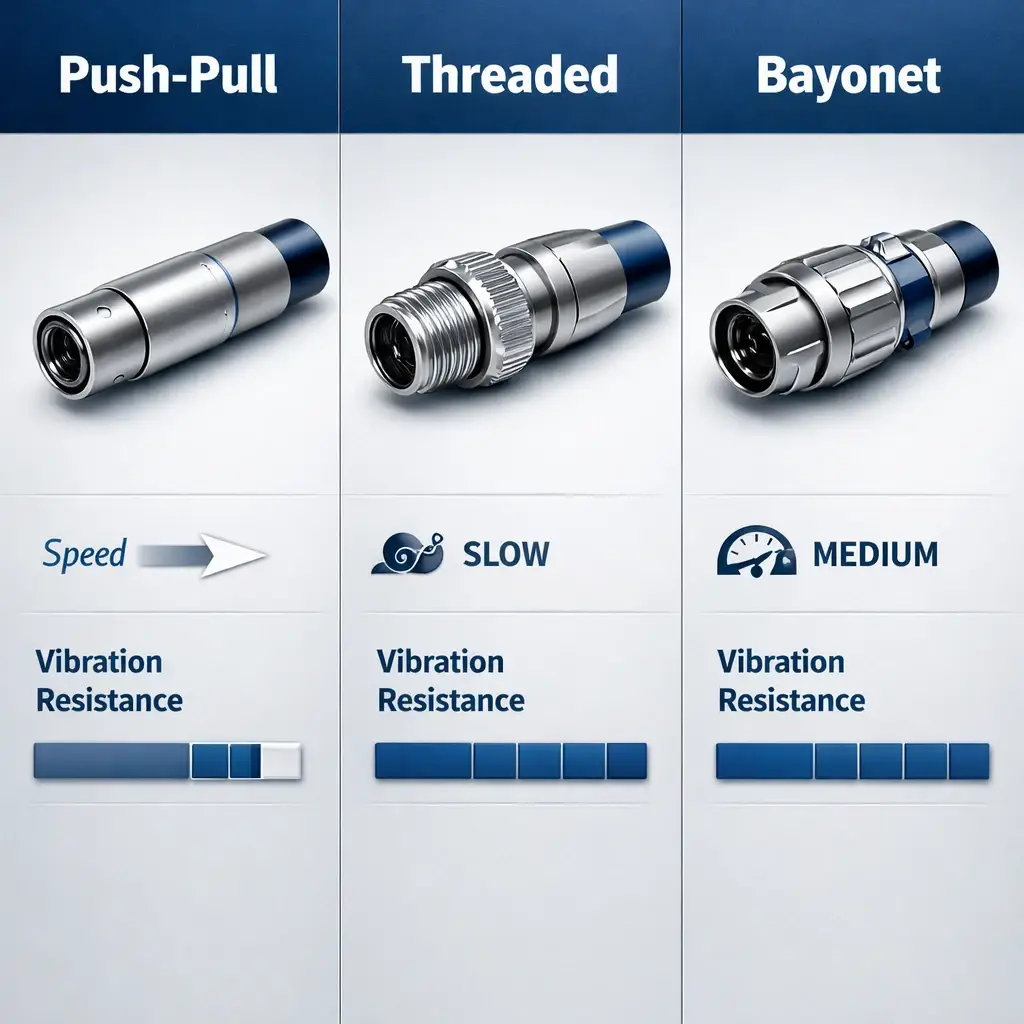
1. Push-Pull Connectors
These connectors feature an automatic locking system. By pushing the plug into the receptacle, the lock engages automatically, and they can only be disconnected by pulling back the outer shell.
- Main Advantage: High-speed connection and disconnection, extremely space-saving (High Density).
- Limitation: High production cost.
2. Threaded Connectors
In this model, the male plug is screwed onto the female receptacle using a threaded nut.
- Main Advantage: Exceptional resistance to vibration and mechanical shocks, highly robust sealing.
- Limitation: Time-consuming connection and disconnection process.
3. Bayonet Connectors
The bayonet mechanism locks with a quick twist (usually one-third of a turn). There are pins on the receptacle body that lock into the spiral grooves of the male plug.
- Main Advantage: Faster connection than threaded types and more secure than simple push-in connections.
Precision male and female connectors are customized with stringent standards based on the specific industry:
Medical Devices
In equipment such as MRI machines, vital signs monitors, and surgical tools, connectors must be capable of repeated sterilization (Autoclavable). This industry utilizes materials such as engineering plastics (PEEK), which are highly resistant to high temperatures and chemicals.
Aerospace & Military
This sector requires connectors that comply with military standards (MIL-SPEC). Mandatory requirements for these connectors include resistance to electromagnetic interference (EMI/RFI Shielding), operation within a temperature range of -50°C to +200°C, and resilience against ballistic shocks.
Industrial Automation and Robotics
In robotic arms, cables and connectors are constantly in motion and subjected to bending. Connectors in this sector must be isolated against noise generated by servo motors, and their pins must be capable of simultaneously transmitting power current and data signals (Hybrid Connectors).
4 Vital Parameters for Selecting and Purchasing Industrial Connectors
To ensure your design does not fail, review this checklist before making a purchase:
- IP Rating (Ingress Protection): Will the connector be exposed to dust (IP65) or submerged in water (IP68)?
- Signal Type: Do you need to transmit high voltage (Power), high-frequency data (Coaxial/Fiber Optic), or a combination of both?
- Available Space: For compact and dense boards, miniature push-pull connectors are the optimal choice.
- Physical Keying: Precision connectors feature guide pins (Keys) to prevent the incorrect mating of a plug to an incompatible receptacle; this feature completely eliminates human error.
Frequently Asked Questions (FAQs)
What is the lifespan (Mating Cycles) of precision connectors?
Depending on the quality of the pin alloy and the thickness of the gold plating, industrial precision connectors typically offer between 5,000 to 10,000 mating and unmating cycles without any increase in contact resistance.
Can military connectors be used for automation applications?
Yes, but it is not economically cost-effective. Military connectors are designed for extremely wide temperature ranges and combat conditions. For automation purposes, industrial precision connectors with an IP67 standard are highly sufficient and much more economical.
What is the best connector for high-vibration environments?
For environments experiencing high vibration (such as industrial motors or railway equipment), threaded connectors are the ultimate choice due to their robust mechanical locking mechanism.
Still hesitating about selecting the right precision connector for your project?
Choosing the wrong material or IP rating can lead to voltage drops or production line downtimes. Our engineering team is fully prepared to recommend the most reliable option based on the sensitive standards and specific requirements of your project.

