
Here is the professional and accurate English translation of your text:
PEEK (Polyether ether ketone) polymer has become the gold standard in the manufacturing of implants and surgical equipment due to its high biocompatibility, unparalleled chemical resistance, and mechanical properties similar to human bone. However, medical PEEK injection molding is considered one of the most complex branches of industrial molding due to the specific thermodynamic behavior of this polymer.
In this specialized guide, we will thoroughly examine the engineering requirements, runner design, thermal control, and the standards required for the successful injection of medical-grade PEEK.
For free consultation, real-time price inquiries, and order placement, please contact us:
- 021-56575111 (Special Office Line)
- 0912-3221757 (Direct Consultation)
- 0900-9504025 (Sales Support)
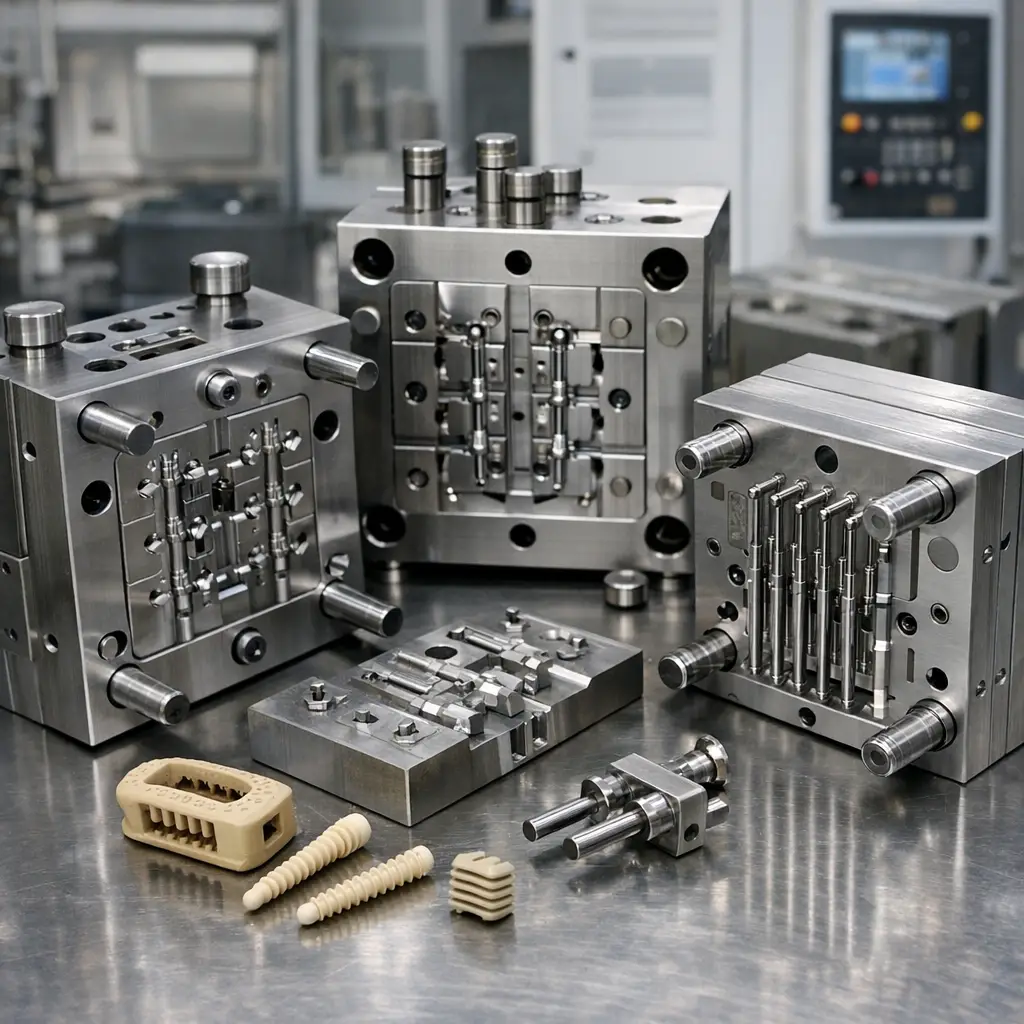
Why is PEEK Injection Molding Different from Ordinary Plastics?
PEEK polymer is a high-performance thermoplastic. The main difference lies in its temperature profile. While ordinary plastics like ABS or Polycarbonate are injected at lower temperatures, PEEK requires a temperature between 340∘C340^\circ C and 400∘C400^\circ C to melt.
In addition to the barrel temperature, the mold temperature itself must be continuously maintained between 160∘C160^\circ C and 200∘C200^\circ C so that the crystallinity of the polymer forms correctly. If the mold is not hot enough, the output part will be brittle, cloudy, and lack the mechanical properties required for medical applications.
Critical Requirements in PEEK Medical Injection Mold Design
To manufacture a mold capable of producing thousands of medical parts with micron-level tolerances, adhering to the following principles is mandatory:
1. Selecting the Appropriate Mold Steel
Due to the extremely high processing temperatures and the potential release of corrosive gases in the event of thermal degradation of the material, standard mold-making steels (like P20) are not suitable for PEEK. The mold must be made from hardened, heat-resistant stainless steels such as H13 or S136 grades (with a hardness of at least 50−54 HRC50 – 54 \text{ HRC}).
2. Thermal Management System
Heating a mold to 200∘C200^\circ C is not possible with water circulation systems. A PEEK injection mold must be equipped with:
- Hot Oil Temperature Controllers
- Or Electric Heaters with precise thermocouples.
Furthermore, the use of Insulation Boards between the mold and the injection machine platens is essential to prevent energy loss and damage to the machine.
3. Runner and Gate System Design
PEEK polymer has a high viscosity in its molten state and solidifies rapidly.
- Runner Thickness: Should be designed at least 20%20\% to 30%30\% larger than runners for standard plastics.
- Gate Type: Pin-point and submarine gates may cause material degradation due to the generation of high shear stress. The use of edge gates or larger direct gates is recommended.
- Hot Runner System: If used, high-temperature specific nozzles (above 400∘C400^\circ C) with independent thermal controllers must be utilized to prevent the formation of cold spots.
4. Shrinkage Management
The shrinkage rate of medical-grade PEEK is typically between 1.0%1.0\% and 2.5%2.5\% (depending on the amount of added carbon or glass fibers). The mold designer must mathematically calculate this shrinkage with precision using simulation software (like Moldflow) to ensure the final dimensions of the implant or surgical tool perfectly match the original drawing.
For free consultation, real-time price inquiries, and order placement, please contact:
- 021-56575111 (Office Special Line)
- 0912-3221757 (Direct Consultation)
- 0900-9504025 (Sales Support)
Production and Injection Standards for PEEK Medical Equipment
Molding medical parts is not limited to just a good mold; the production environment must also be isolated:
- Cleanroom Production: PEEK injection for permanent implants (such as spinal cages) must be performed in ISO Class 7 or 8 cleanrooms to prevent suspended particles and biological contaminants from entering the polymer matrix.
- Compliance with ISO 13485: All stages of mold design, initial trials (T0, T1), and mass production must be documented under a medical device quality management system.
- Preventing Cross-Contamination: The barrel and screw of the injection machine must be thoroughly cleaned with specific Purging Compounds at high temperatures before being used for medical PEEK. No traces of previous polymers should remain in the barrel.
Frequently Asked Questions (FAQ)
Question: What should the mold temperature be for medical PEEK injection?
Answer: The mold temperature for PEEK injection must be continuously maintained between 160∘C160^\circ C and 200∘C200^\circ C to ensure the polymer crystallization process occurs properly and the part possesses full mechanical properties.
Question: What is the best steel for making a PEEK injection mold?
Answer: Due to the very high processing temperatures (up to 400∘C400^\circ C), the best choice is using hardened stainless steels like H13 or S136 with a hardness above 50 HRC50 \text{ HRC}.
Question: Are PEEK-injected parts sterilizable?
Answer: Yes, medical-grade PEEK is highly resistant to all common sterilization methods, including autoclave (hot steam), gamma irradiation, and Ethylene Oxide (EtO) gas, without losing its properties.
Conclusion
Designing and manufacturing a PEEK medical injection mold requires interdisciplinary expertise in thermodynamics, metallurgy, and biomedical engineering. Investing in high-quality steels, precise thermal control systems, and pre-manufacturing simulations is the only way to guarantee the production of parts that can pass strict FDA and CE standards and ensure patient safety.
For free consultation, real-time price inquiries, and order placement, please contact:
- 021-56575111 (Office Special Line)
- 0912-3221757 (Direct Consultation)
- 0900-9504025 (Sales Support)

